About Yari Ostovany
Yari Ostovany
Contemporary Artist
Yari Ostovany is a contemporary artist whose process-driven abstract practice explores the intersection of the spiritual, the psychological, and the material. Born in Iran and based in the San Francisco Bay Area, his work reflects a lifelong inquiry into transformation, memory, and the unseen forces that shape experience.
Ostovany immigrated to the United States at the age of sixteen and pursued his artistic education at the University of Nevada, Reno, before earning his MFA from the San Francisco Art Institute in 1995. His background, shaped by multiple cultural and philosophical traditions, informs a practice that draws equally from Western abstraction and Eastern aesthetic sensibilities.
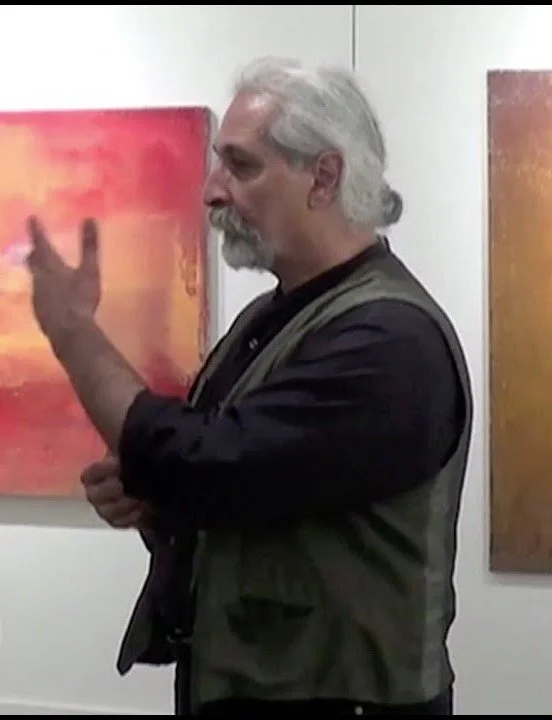
"I see abstraction as representational insofar as it is a representation of a psychic state, not an external reality."
Working improvisationally, Ostovany builds his paintings through extended, layered processes that emphasize accumulation, erosion, and revision. Beginning often with calligraphic gestures, forms emerge and dissolve through successive applications of washes, glazes, and textured surfaces. Paint is pushed, scraped, rubbed away, and reapplied, allowing light, gravity, and chance to guide the evolution of the work. Through this method, distinctions between foreground and background gradually collapse, giving rise to compositions that suggest movement, resonance, and depth rather than fixed imagery.
At the core of Ostovany’s practice is an interest in abstraction as a record of inner states rather than external representation. His paintings function as translations of experience—visual evidence of psychic and emotional energy rendered through light, color, and texture. Drawing on influences ranging from Abstract Expressionism to Persian calligraphy and Zen philosophy, his work occupies a liminal space between emergence and disappearance, stasis and motion.
Ostovany has exhibited internationally and is the recipient of multiple grants, including awards from the Center for Cultural Innovation and the Sierra Nevada Arts Foundation. His work is held in the permanent collections of institutions in the United States, Europe, and the Middle East.